













This store requires javascript to be enabled for some features to work correctly.

Item #: N-22539
Artist: Louis Comfort Tiffany
Country: United States
Circa: 1925
Dimensions: 28.00" length
Materials: 1 oval-cut amethyst (weighing approximately 88.00 carats); 7 circular-cut amethysts (approximate total weight 4.10); 33 lapis lazuli beads; 30 turquoise beads; 6 amethyst beads; Enamel; 18K Gold
Gram Weight: 73.9
Signed: Unsigned, accompanied by certificate of expertise by Annamarie Sandecki, former Director of Tiffany & Co. Archives and founding member of IAJA stating that the pendant necklace is a genuine Tiffany & Co. item.
Documentation: Accompanied by expertise report no. XP3307-121026 by Annamarie V. Sandecki of IAJA dated October 12, 2026 stating that this "Grapevine" pendant necklace is a genuine Tiffany & Co. item, designed by Meta Overbeck for Louis Tiffany.
Literature: The original watercolor and gouache design for the pedant is preserved at the Charles Hosmer Morse Museum of American Art, Winter Park, Florida, and reproduced in the museum's volume Meta Overbeck's Designs for Louis C. Tiffany Art Jewelry, p. 38. A similar necklace in opal and multicolor sapphire is held in the Tiffany Archives, and is illustrated in Bejewelled by Tiffany 1837-1987, by Clare Phillips, p. 244.
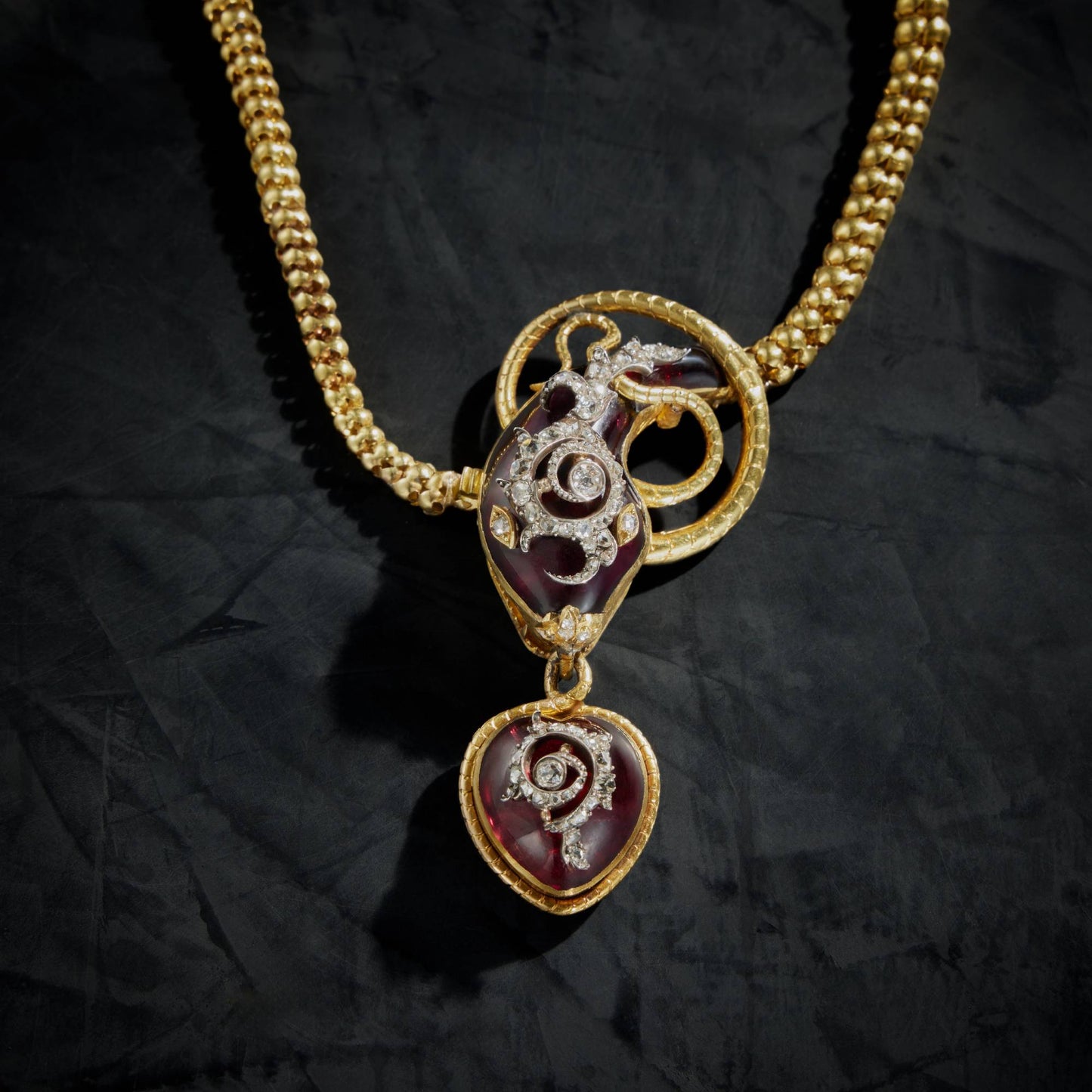
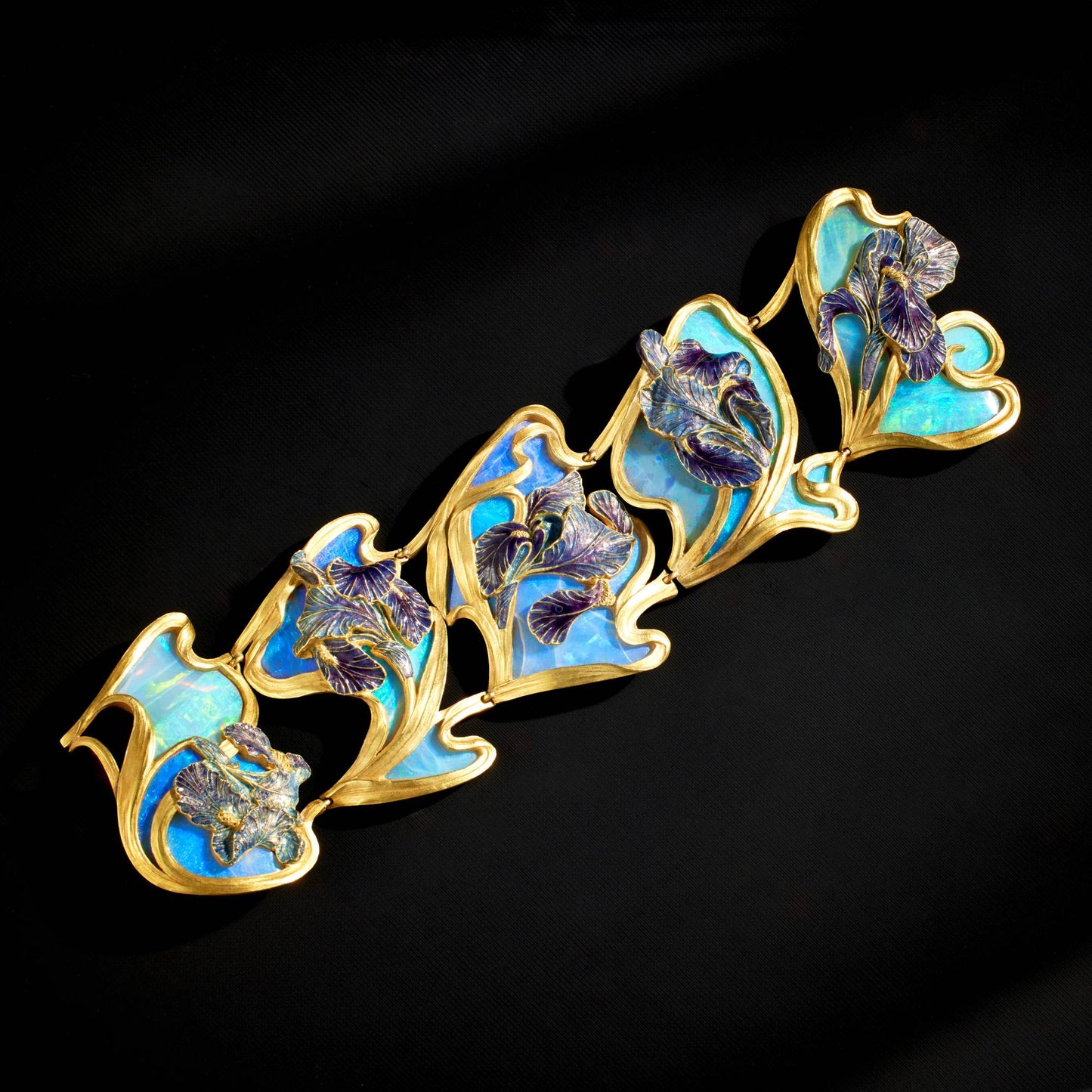
An elaborate composition of enamel leaves and hardstone grapes in different stages of ripeness, all entwined in a thicket of coiling gold vines and tendrils, this pendant necklace belongs to the body of naturalistic jewels created by Louis Tiffany and his second head of workshop of long tenure, Meta Overbeck. Enhancing the illusion of an organic origin to his work, Tiffany buried the amethyst within a profusion of leaves, which serve in place of prongs to hold the gem securely entangled within its polychrome and gold nest.
According to former Tiffany archivist Janet Zapata, Overbeck and Tiffany created "naturalistically treated mountings of vines and leaves, arranged with less emphasis on symmetry" between 1915 and 1925. The art jewelry department had been on site at the firm's Stanford White headquarters on Fifth Avenue and 37th Street since 1909, and jewels were advertised in the Blue Book as "designed and made under the personal supervision of Louis C. Tiffany" - a task that took him several hours a day. Tiffany's work flow, by this point, was to "sketch his idea on paper" after which "Miss Overbeck...would make a watercolor cartoon..." followed by a "wax model" on which to form the jewel in three dimensions (not to be associated with casting methods). The jewels were then hand made in the department, which was staffed by between two and six employees during Overbeck's leadership.
Both Tiffany and Overbeck studied Greek jewelry, in which dark red and purplish stones, typically garnets, were associated with natural abundance, regeneration, and "the purple flood of wine," as Zapata described these jewels' sensibility.
An analogous elaborate grapevine pendant necklace in black opal, multi-color sapphire, and enamel is held in the Tiffany Archives, while another of violet and pale blue sapphires, and once belonging to Hélène Arpels, is currently on loan to the Metropolitan Museum of Art, and displayed in the American Wing with two Louis Tiffany necklaces of comparable opulence. While these related necklaces explore the theme of the grapevine and the lyricism of natural forms, they do so in distinctive and original ways, and are all unique.
445 Park Avenue
New York, NY 10022
+1 (212) 644-6400
email@macklowegallery.com
Open to the public
Monday- Friday 10:30 AM - 5:30 PM
For more information on Macklowe Gallery,
please contact email@macklowegallery.com