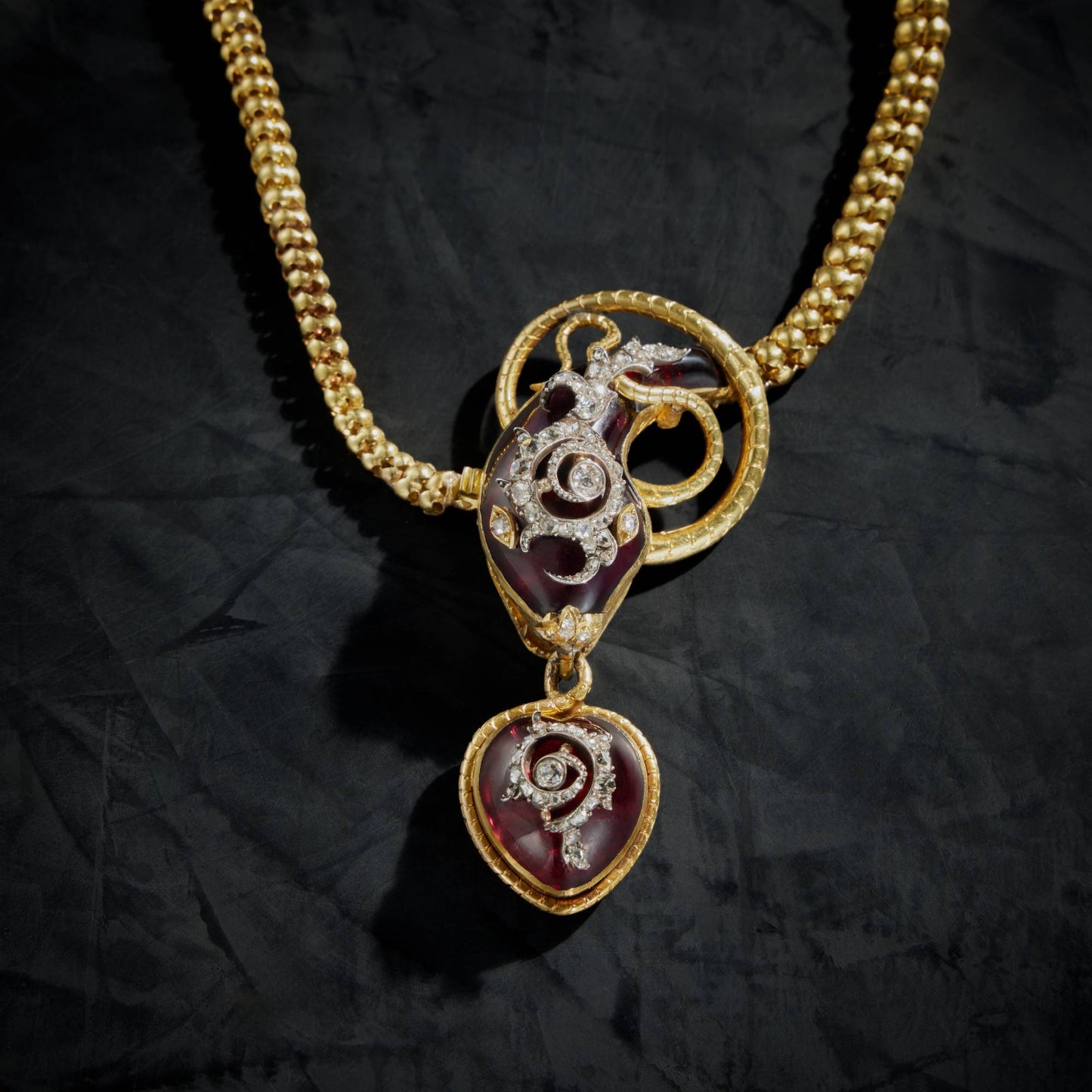

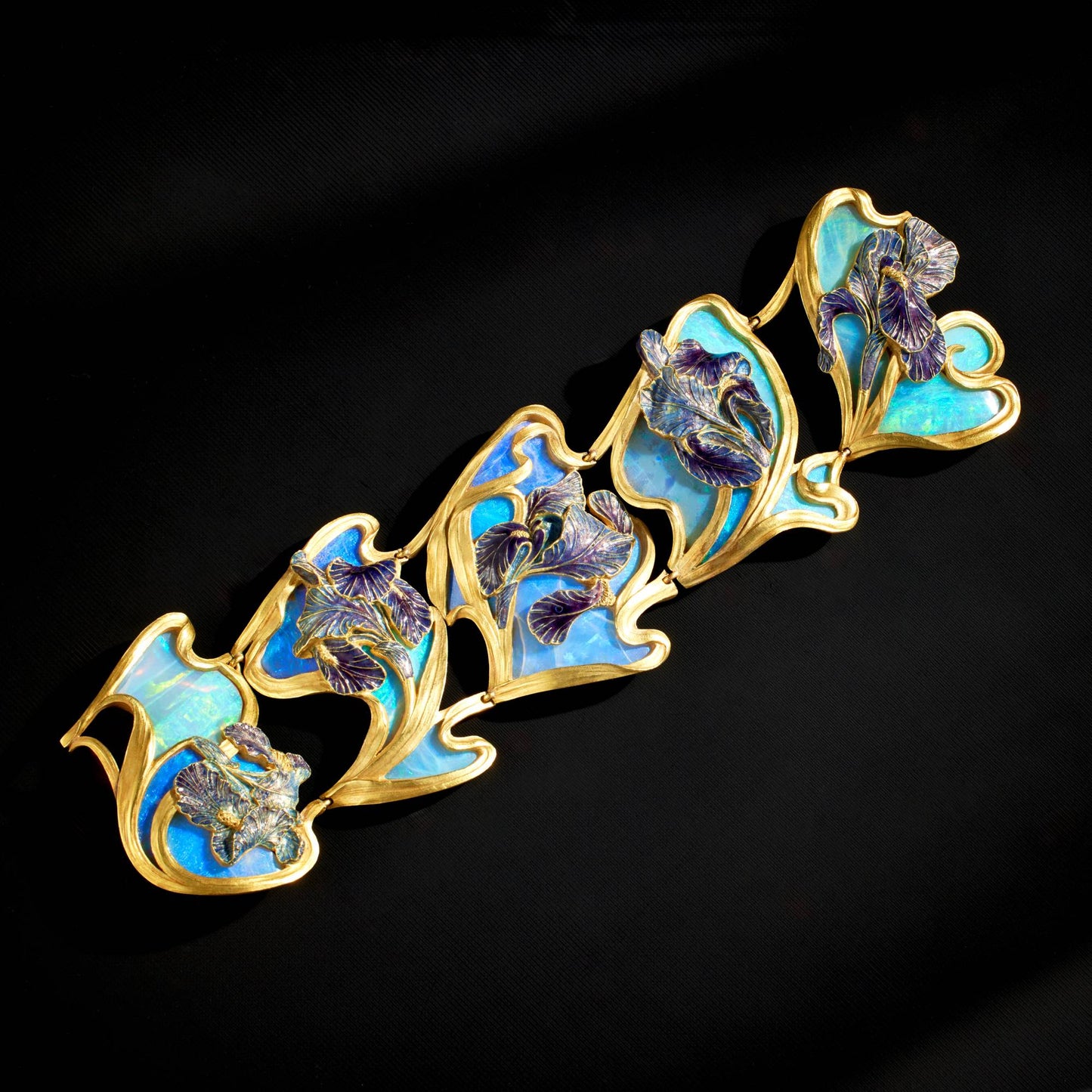

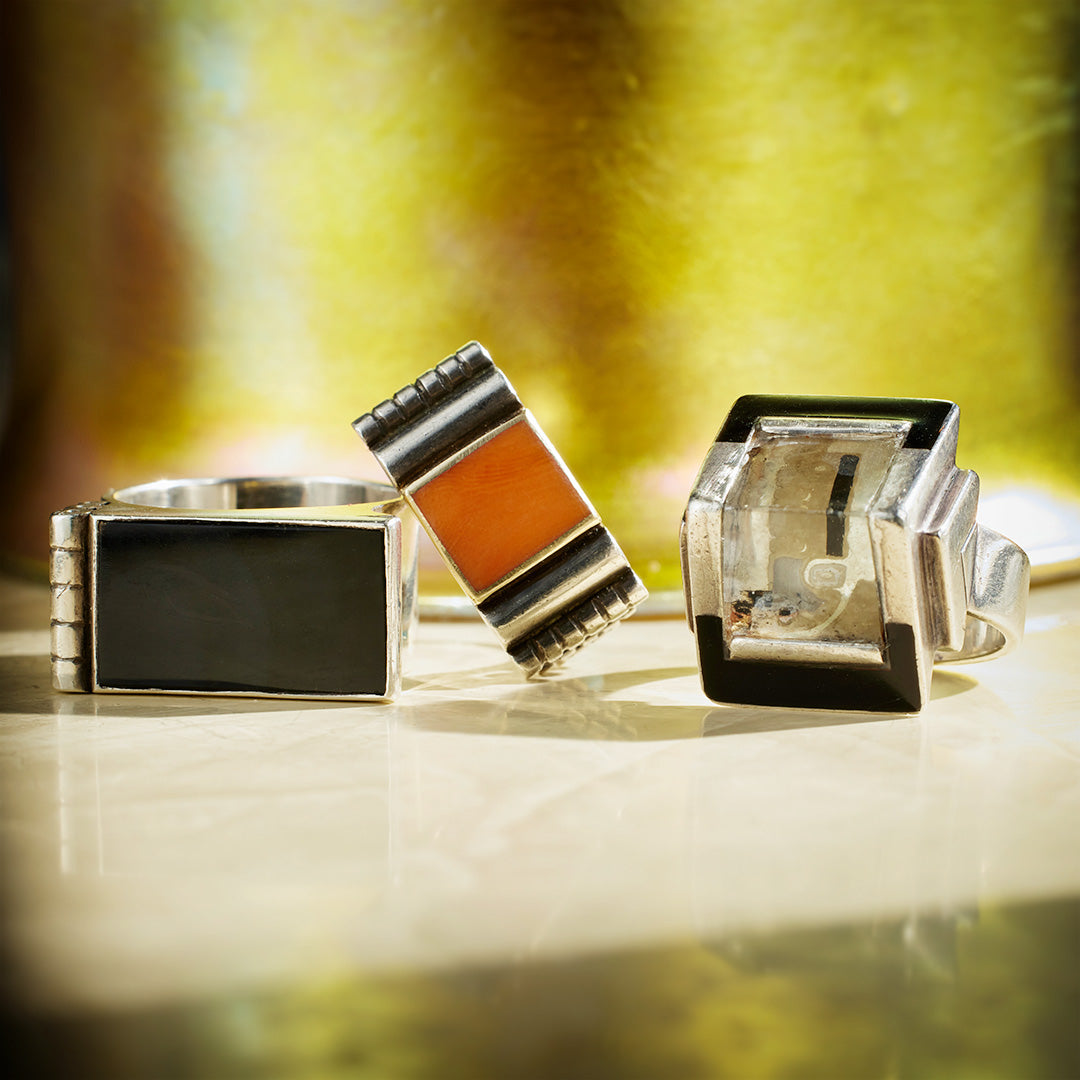












Enameling holds a unique place among the jewelry arts of France. In the 1800s, Parisian workshops revived long-lost techniques that had been shrouded in romance and mystery. Artisans studied the luxury enamels of medieval Limoges, the writings of Renaissance master Benvenuto Cellini, and the Louvre’s archaeological treasures. They sought out contemporary masters from Japan to learn their secrets. With dedication and creativity, they re-discovered how to fire enamel’s humble components - powdered glass made of sand, soda ash, limestone, and mineral oxides - onto sculpted gold forms to create objects of enduring artistic and cultural value.
Far beyond surface decoration, enamel is the result of repeated firings, precise control of temperature, and patient study of how layered glass interacts with light. Techniques such as cloisonné, champlevé, plique-à-jour, and pailloné represent ingenious solutions to the challenge of how to bind glass to gold while maximizing brilliance, depth and color. French enamelists achieved glowing, gem-like hues that enhanced the palette of traditional stones, while for Art Nouveau jewelers, enamels accessed nature’s vast range of colors and light effects.
Demonstrating total technical expertise, French jewelers used enamels with renewed elegance and expressive power to respond to the important art movements of the time. Their tireless experimentation elevated enameling to new heights, and made the art a vehicle of modern design.
Cloisonné

Cloisonné enameling was an innovation on ancient Egyptian inlay techniques, where well-defined cloisons, or shaped wire compartments, were used to create pictorial motifs and patterns. The Mycenaeans first directly fused colored enamels into these thin wire cloisons. The complex technique requires firing successive layers of enamel to achieve a smooth, level surface and intense color saturation, while the gold wire remains visible, delineating designs with graphic clarity.
Multiple Parisian workshops took up the challenge of rediscovery, but few with the energy and ingenuity of father-son partners Alexis and Lucien Falize. Together with freelance enamelist Antoine Tard, they became the foremost masters of cloisonné in the 1860s. Falize jewels were acquired by museums like the South Kensington and the Ashmolean. Retailers like Maison Boucheron, Tiffany & Co., and Cartier sold them to their most sophisticated clients. As a contemporary expert and collector noted in 1869, Falize jewels were “very costly…(and) unlikely to come down in price…since each is unique, and there are technical difficulties…”
The exterior of this magnificent Falize bracelet is decorated in layered, transparent red and blue enamels suspending gold foils (paillons). In contrast, its interior is a master class in cloisonné. On the smooth interior surface, realized in the firm’s luminous and distinctive blue, the shining gold lines of the cloisons depict ivy vines, berries, and the symbolism of eternal love. Numerous gifted artisans completed this piece together over months, with the gold and glass representing only a tiny fraction of the bracelet’s price. Due to the value of the human capital devoted to them, these enamel jewels were among the most expensive to produce in history.
Champlevé

Left: French Jarretière Bracelet, c. 1870-1880; Champlevé enamel contour lines lend this jewel a sense of modern styling
Champlevé is enamel filled into depressed fields, channels or shaped areas created by engraving, stamping, chasing or repoussé. The name translates, counterintuitively, as “raised field”, likely an evolution of “chant levé”, or “raised edge”, referring to the high walls left after carving out recesses in the gold.
Like cloisonné, champlevé was among the lost arts of medieval Limoges, where craftsmen created enamel luxury objects to satisfy royal and religious commissions from throughout Europe. Achieving extraordinary saturation in blues, greens, and reds, enamelists portrayed complex scenes and imagery. Revitalized in the 19th century by Louis Houillon, Étienne Tourette, and Falize, champlevé enamels enriched a wide variety of jewelry styles, from designs that responded to the streamlined geometry of the early machine age (Fig. 2 and 2a) to the curved surfaces of case watches showcasing exuberant studies of plant forms by René Lalique.

Basse-taille (“Shallow-cut”) is a sophisticated translucent variety of champlevé, made by chasing and engraving recesses in the gold to create relief patterns producing shading, gradation, and texture. As light penetrates the enamel and reflects off the sculpted surface below, it returns to the eye softened, colored, and patterned, lending drama to jewels. Lucien Falize and Emile Pye mastered bassetaille enameling, further adding in paillons of gold foil to create an animating effect.


Plique-à-jour Enamel Inspired by Cellini’s Treatises (1568), Parisian workshops also re-discovered the secrets of plique-à-jour, the most technically-demanding enamel ever perfected. In this method, which requires a series of specialists in repoussé, saw-piercing, polishing, enameling, and surfacing, translucent, backless enamel is suspended within delicate gold pierce-work. Creation of a “plique” jewel face risks at every step - uneven enamel thickness, structural weakness, or firing errors can all lead to partial or total loss of months of collaborative work.

One of the plique’s top practitioners was René Lalique. Plique’s transparency and fragility enhanced the sense of organic life of his naturalistic jewels - particularly on leaves, wings, and petals. This Lalique ivy pendant with its disciplined palette of pale green plique leaves, enhanced by blue champlevé berries, expresses the artist's devotion to France's humble, native plants and flowers. Lalique’s residence/atelier at 20 rue Thérèse (1890-1902) was outfitted with a muffle furnace suited for firing enamel, making it possible that the artist himself enameled these pieces.

Another enamelist trained by Louis Houillon and Étienne Tourette, Éugene Feuillâtre was possibly a one-time Lalique collaborator, and certainly a worthy competitor in his own right by 1900. Feuillâtre’s necklace of eight luminous plique-à-jour butterflies is highlighted by shimmering paillons. These are a feature of paillonné enameling, an 18th-century technique combined with champlevé and, later, plique, and consisting of gold or silver foils suspended within these translucent enamels. Paillons were a flourish that Lalique too embedded in the wings of his dragonflies to simulate the small sparkling inclusions he had observed in actual specimens. Feuillâtre’s butterflies are ingeniously linked by leafy pearl buds via their own delicate antennae - the necklace is elegant, light, and very wearable.

An unequalled virtuoso jewel is represented by the plique-a-jour enamel iris (Fig. 8), designed by Marcus & Co. and created around 1906 by a group of unknown French collaborators at the height of their powers. Its masterful color transitions, both in the flowers and leaves, are painterly and yet also awe-inspiring in their evocation of complex, evanescent plant life. Its botanically-accurate form is a marvel of goldsmith’s arts of repoussé and saw piercing, while its seamless construction enhances the illusion that it grew organically. This jewel is accompanied by a second example in the Macklowe collection, the Marcus orchid, also of virtuoso coloration and three-dimensionality, another museum-worthy work of art by this team of as-yet-unidentified French artisans.
Enamel jewelry as a form of adornment and self-expression is one of the most personal and dramatic ways to communicate a love of creativity and imagination. In these luxury pieces, tradition, innovation, and virtuosity converge, resulting in wearable artworks.